Okay, today we're on pho
Transcribe your lectures. Serona turns them into notes, quizzes, and an organized study plan.
Unit 7 Quiz: Memory
Answer every question. Starred questions match what your professor emphasized in lecture.
It all starts with the input.
Serona listens to your lectures and reads your screenshots, notes, and documents.
Your math notes should not look like your history notes.
Every class gets its own style of note, and you decide what that is. Pick what fits you and the subject.
A review that knows what matters.
The same class becomes a focused review with priorities, formulas, and the concepts that still need attention.
The class you cannot take notes in.
Seminars and book discussions have no board to copy. Roundtable captures the conversation itself: what got asked, what people actually said, and where the room landed.
Unit 3: Linear Equations
Overview
Point-slope form is the equation of a line built from one known point and the slope. Plug both facts in, simplify, and the full line falls out as y = mx + b.
Point-Slope Form
You have a point on the line but not the intercept.
Answer: y = 3x + 1, the equation of the line
Your math notes should not look like your history notes.
Every class gets its own style of note, and you decide what that is. Pick what fits you and the subject.
Unit 3: Linear Equations
Overview
Point-slope form is the equation of a line built from one known point and the slope. Plug both facts in, simplify, and the full line falls out as y = mx + b.
Point-Slope Form
You have a point on the line but not the intercept.
Answer: y = 3x + 1, the equation of the line
Conditioning and Learning
Overview
This session covered how reward timing shapes behavior: the four schedules, their patterns, and the one fact exams love.
Schedules of reinforcement
Ratio schedules count behaviors, and interval schedules count time. The unpredictable ones hold up best when rewards stop.
| Schedule | Pattern |
|---|---|
| Fixed ratio | high rate, pause after each reward |
| Variable ratio | highest and steadiest, hardest to break |
| Fixed interval | ramps up as the deadline nears |
| Variable interval | slow and steady |
Fixed interval: cramming right before each quiz
Common mistake: Negative reinforcement is not punishment.
Exam watch: “There will be a gambling question on Friday’s quiz. When you see it, the answer is variable ratio.”
The Great Gatsby Seminar
Session Overview
Most of the hour went to one question: does Gatsby love Daisy, or the life she represents? The room split early and never fully came back together.
Most of the class read the obsession as ambition: Daisy is shorthand for the life Gatsby was locked out of. A smaller group held out for real love, pointing to the five years of letters.
Classmate: “He isn’t in love with Daisy. He’s in love with 1917.”
Professor: “Then ask what happens to the dream the moment she says yes.”
View: The green light only matters while it is out of reach.
Counter: Chapter 5 shows him happiest with Daisy actually in the room.
Where we landed: No consensus. The ambition reading held the room, but the letters kept it an open question.
Every line of your study guide, backed by receipts.
Import a study guide and Serona checks it against every source from class. Each topic is pinned to where it was covered, and anything missing is flagged.
One for tomorrow’s test. One for next week’s.
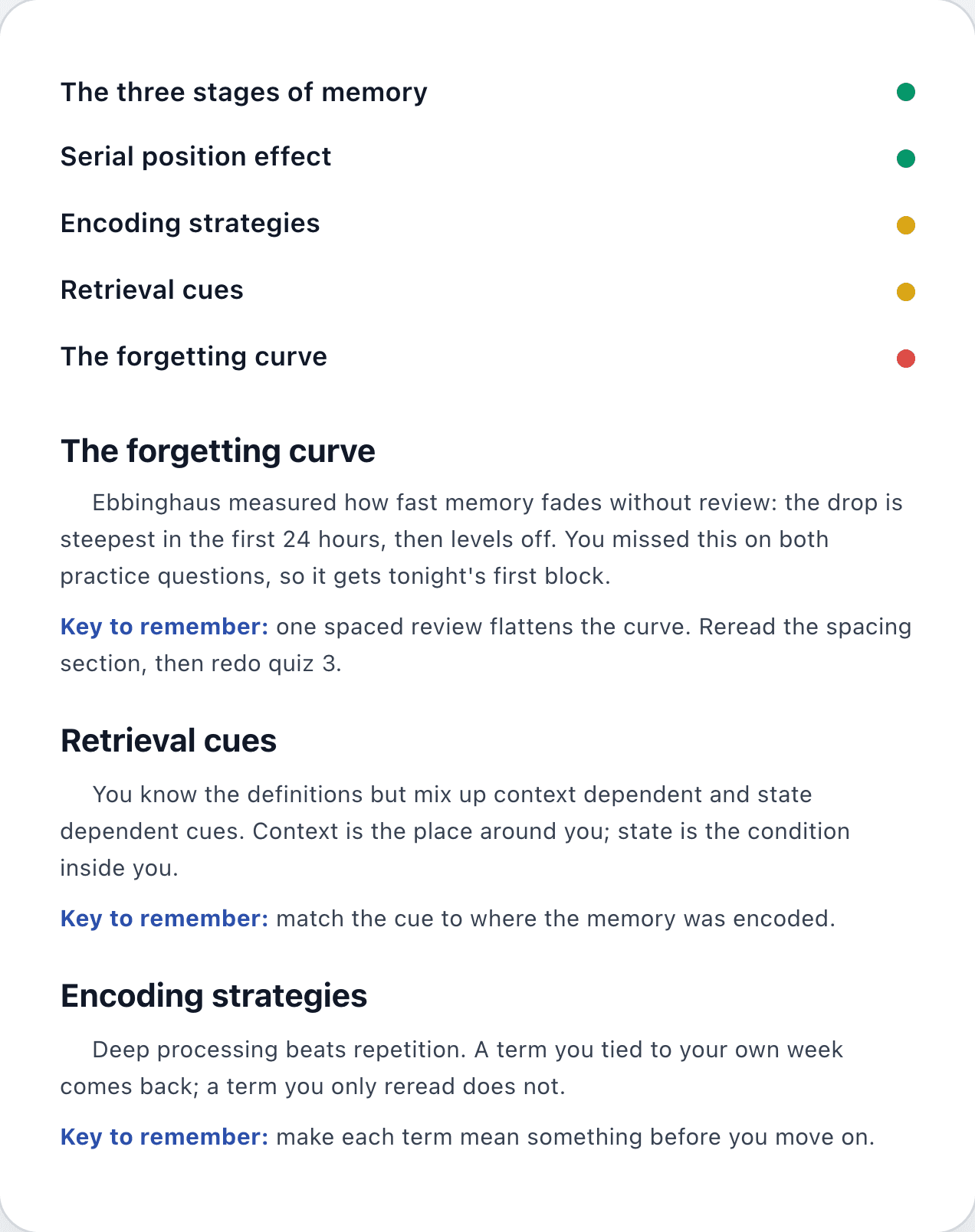
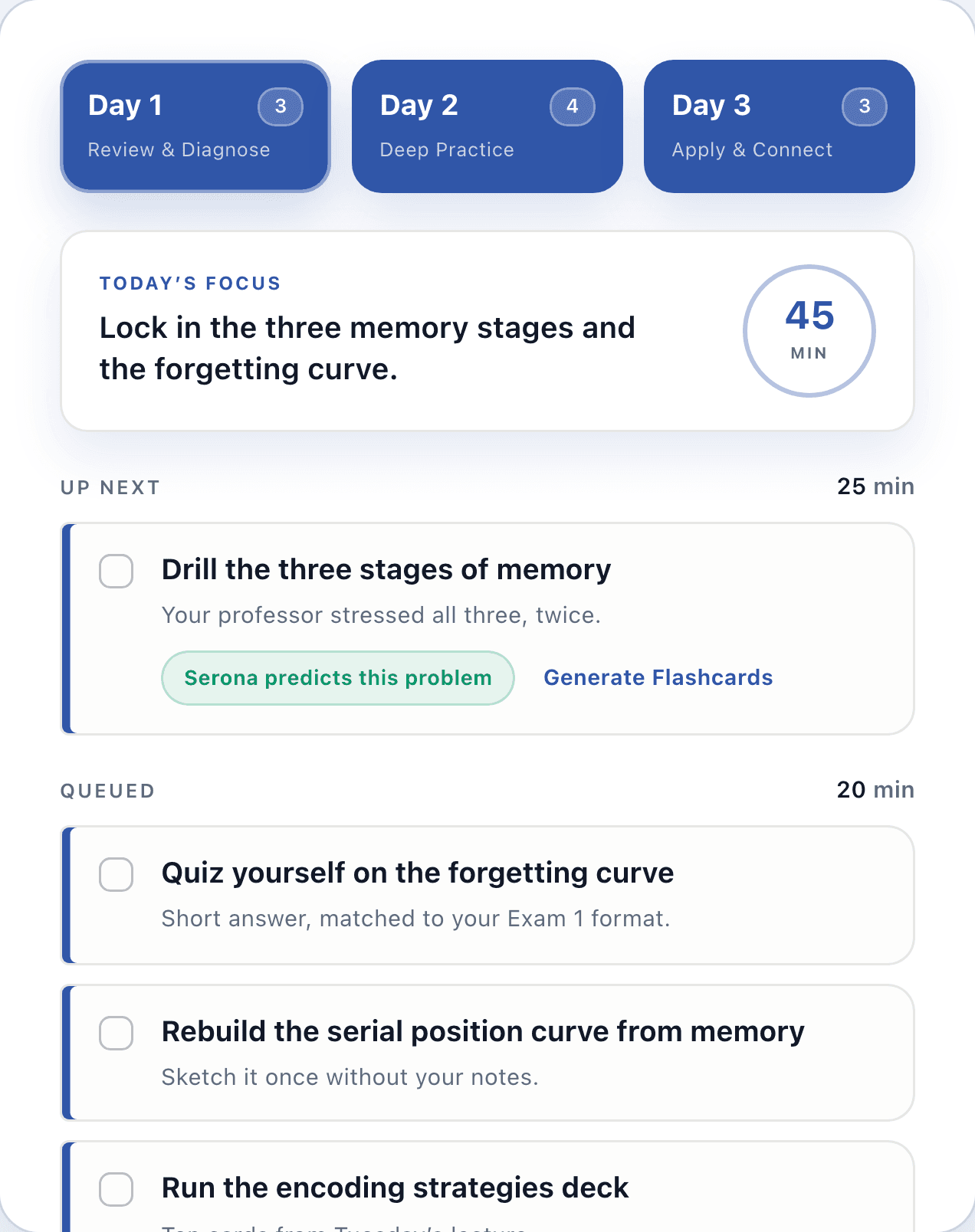
A Study Guide is the whole unit on one page, for when the exam got closer than you planned. Study Mode takes the days you still have and spends them where the points are.


The rest of your study system.
Stay organized, know what matters, and remember it when the test arrives.
Syllabus tracking
Screenshot a syllabus. Serona finds every date and adds it to Upcoming deadlines.
“This will be on the exam.”
Exam prediction
See what your teacher emphasized and the question you should practice next.
Flashcards
Turn the material that matters into a focused stack built for active recall.